
Ultimate Guide to Social Engineering in Healthcare
Social engineering attacks in healthcare exploit human vulnerabilities rather than technical flaws, making them a major security threat. These attacks often target healthcare staff, leveraging high-stress environments and outdated systems to gain access to sensitive patient data.
Key points:
- 98% of cyberattacks involve social engineering, with phishing, vishing, and pretexting being the most common tactics.
- Patient records are prime targets due to their unchangeable nature (e.g., Social Security numbers, medical histories).
- AI-driven scams have surged by 1,265% since late 2022, using tools like deepfake voices to make attacks more convincing.
- Consequences include disrupted patient care, financial losses, and loss of trust in healthcare organizations.
To counter these threats, healthcare organizations must:
- Train staff to recognize phishing, vishing, and AI-powered scams.
- Implement technical safeguards like multi-factor authentication and AI threat detection.
- Enforce strict identity verification protocols and physical security measures.
Proactive strategies and secure communication tools, such as Eleidon’s trust-based messaging platform, can reduce risks and protect patient data.
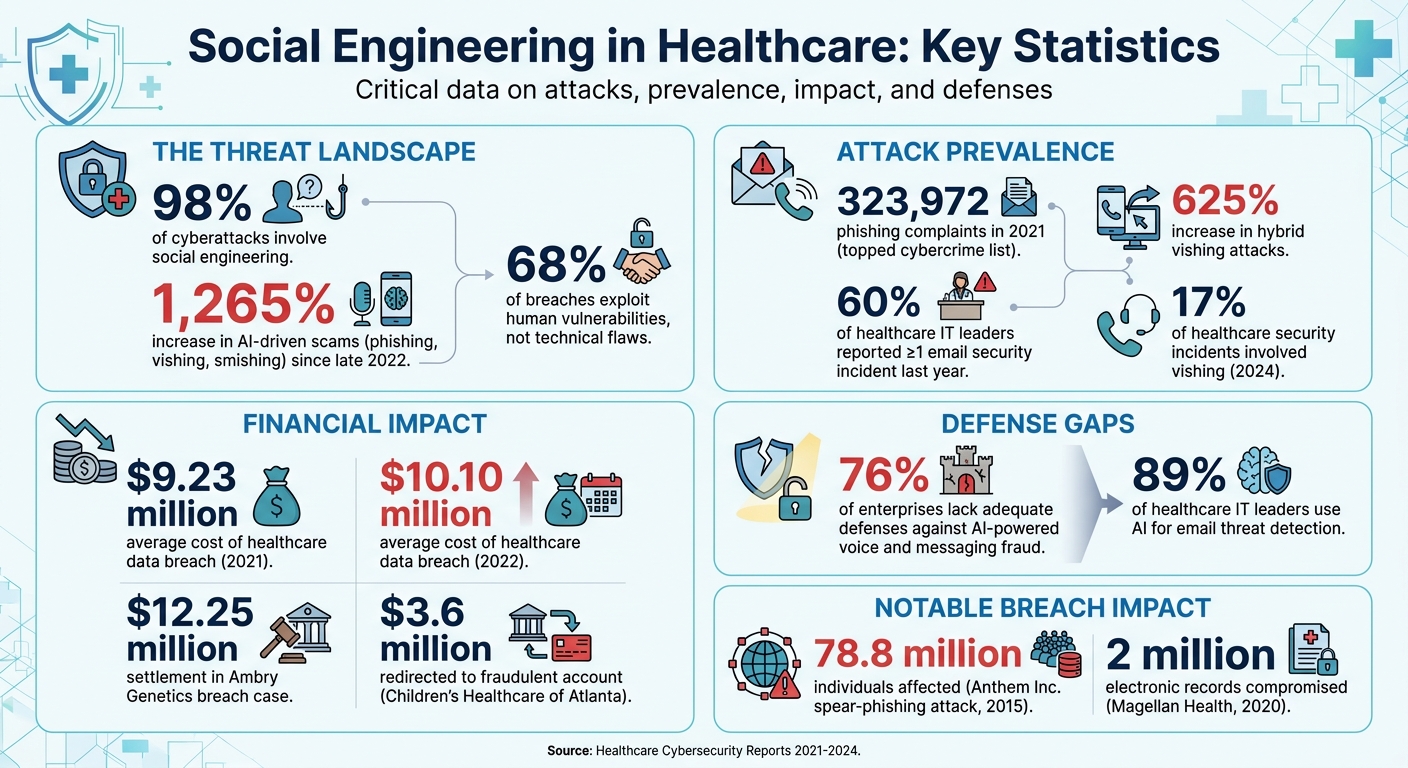
Social Engineering Attack Statistics in Healthcare 2024
Protect your org from social engineering | Healthcare Strategies
sbb-itb-804866a
Types of Social Engineering Attacks in Healthcare
Healthcare organizations face a variety of social engineering attacks that exploit human behavior and psychological vulnerabilities. These attacks often take advantage of the high-pressure environment of healthcare settings, using different communication channels to bypass security measures.
Phishing and Spear Phishing
Phishing casts a wide net, sending fraudulent emails to large groups in hopes that someone will click on a malicious link or download an infected attachment. In 2021, phishing topped the list of reported cybercrimes, with 323,972 complaints filed.
Spear phishing, however, is more targeted and dangerous. Attackers research specific individuals or departments - like HR or IT - to craft highly convincing messages. These messages often include real names, job titles, and internal details to appear legitimate. For example, in January 2015, Anthem Inc. fell victim to a spear-phishing attack where emails impersonating trusted entities tricked employees into revealing credentials. This breach exposed the electronic protected health information of nearly 78.8 million individuals.
The financial impact of such breaches is staggering. The average cost of a healthcare data breach rose from $9.23 million in 2021 to $10.10 million in 2022. On top of that, 60% of healthcare IT leaders reported at least one email-related security incident in the past year.
But phishing isn’t limited to emails. Similar tactics are used over the phone, as detailed below.
Vishing and Phone Impersonation
Vishing, or voice phishing, uses phone calls to trick victims. Attackers often pose as IT staff or hospital officials, pressuring employees to share passwords or authorize unauthorized devices. These schemes have become more sophisticated, with hybrid vishing attacks increasing by 625%.
AI tools have made vishing even harder to detect. Deepfake technology can now replicate the voices of colleagues or supervisors with alarming precision. A 2024 survey revealed that vishing was involved in 17% of healthcare security incidents, while 76% of enterprises reported insufficient defenses against voice and messaging fraud powered by AI.
A real-world example occurred in April 2020, when Magellan Health was targeted. A hacker impersonated a legitimate client over the phone, which led to malware deployment. This breach initially affected 365,000 patient records, but later reports revealed that nearly 2 million electronic records were compromised.
While phone scams often rely on urgency, some attackers take a slower, more calculated approach through pretexting.
Pretexting and Impersonation
Pretexting involves creating a believable backstory to gain trust and extract sensitive information. Attackers might pose as auditors, new employees, or even patients to gain access to restricted areas or data. Unlike phishing, which thrives on urgency, pretexting builds trust over time.
In 2022, Children's Healthcare of Atlanta fell victim to a business email compromise attack. Threat actors spoofed the email domain of a construction company working on a campus project. This deception led the hospital to redirect $3.6 million in payments to a fraudulent account.
Lee Kim, Senior Principal of Cybersecurity & Privacy at HIMSS, emphasizes: "Social engineering is the common root cause behind many security incidents in healthcare".
The collaborative and patient-focused culture in healthcare - while vital - can also be exploited. Attackers often appeal to a sense of urgency or duty, prompting staff to bypass security measures to help patients or colleagues. These tactics highlight the need for strong defenses tailored to the unique challenges of healthcare environments.
Impact of Social Engineering on Healthcare Organizations
Social engineering attacks wreak havoc on healthcare organizations, affecting patient care, financial stability, and public trust.
When it comes to patient care, the consequences are severe. Ransomware attacks and system breaches can force hospitals to reroute ambulances, delay critical surgeries, and cancel important procedures entirely. Without access to digital systems, healthcare providers often fall back on manual, paper-based processes. This shift increases the likelihood of medication errors and disrupts communication between care teams, putting patients at risk of receiving inadequate or delayed care.
The financial toll is equally alarming. Beyond the expenses highlighted earlier, healthcare organizations face costs like wire transfer fraud, ransomware payments, regulatory fines, legal fees, and lost income from operational downtime.
Perhaps most damaging is the erosion of trust. When breaches make headlines, patients, clinicians, and business partners may lose confidence in the organization’s ability to protect sensitive information. Patients might withhold critical details about their medical history or avoid seeking preventative care altogether, which can lead to delayed diagnoses and incomplete treatments. Healthcare organizations with a history of security failures may also struggle to attract top talent, further compounding their challenges.
"Boards should understand that it is a matter of when, not if, they will have an incident." - Kathleen Ann Mullin, CISO, Healthmap Solutions
Healthcare Breach Case Studies
Real-world examples highlight these challenges. In 2020, Ambry Genetics experienced a breach when hackers accessed an employee’s email account containing sensitive patient information. The fallout included multiple class-action lawsuits, with plaintiffs alleging inadequate cybersecurity measures and violations of HIPAA notification requirements. The company eventually agreed to a $12.25 million settlement, which covered credit monitoring, identity theft protection, and reimbursement for affected individuals’ out-of-pocket expenses.
The long-term liability of these breaches is staggering. Medical records often contain unchangeable data - such as Social Security numbers, birthdates, and detailed medical histories - that can be exploited for years. Unlike credit cards, which can be canceled and replaced, this information remains vulnerable to misuse indefinitely, fueling risks like insurance fraud and blackmail.
These wide-ranging consequences emphasize the critical need for proactive security measures, which are explored in the next section.
Prevention Methods for Healthcare Organizations
To combat social engineering threats, healthcare organizations need a multi-layered defense strategy. This approach combines staff training, technical safeguards, and physical controls to minimize risks and protect sensitive patient information.
Staff Training and Awareness Programs
Did you know that around 68% of breaches exploit human vulnerabilities instead of technical flaws? This makes regular cybersecurity training not just a good idea but a necessity - and it’s also required by HIPAA for covered entities and business associates. Phishing simulations play a big role here, offering employees hands-on practice to identify malicious content. These exercises also provide immediate feedback, reinforcing key lessons and aligning with the HIPAA Security Rule’s emphasis on "security reminders."
"A well-educated workforce is the first line, and often the best line, of defense to halt a cyber-attack before it starts." – HHS OCR
Training programs must also evolve to address modern threats. Since ChatGPT launched, AI-driven attacks like vishing, smishing, and phishing have surged by 1,265%. Attackers now use AI to create deepfakes and voice clones, making scams more believable. Employees should be trained to recognize red flags - like unnatural skin tones, unsynchronized lip movements, or odd eye blinking during video calls - and to verify urgent requests through pre-approved, separate communication channels.
Tailored training for specific roles is equally important. For instance, IT help desk staff often face phishing attempts disguised as password reset or MFA enrollment requests. Similarly, C-suite executives are frequent targets of high-stakes "whaling" attacks. Providing role-specific guidance ensures these employees are better prepared for the unique challenges they face.
"Cybersecurity should be everyone's responsibility. Leadership must set the tone by prioritizing digital security and reinforcing that protecting patient data is part of patient care." – Allegrow
Encouraging a culture of reporting is another key step. Employees need clear protocols to report suspicious emails, calls, or requests promptly. Quick reporting ensures that CISOs and CIOs can act swiftly to address potential threats.
While an informed workforce is the first line of defense, technical safeguards provide a critical safety net.
Technical Security Measures
Multi-factor authentication (MFA) is a cornerstone of cybersecurity, blocking unauthorized access even if login credentials are stolen.
AI-driven threat detection systems are becoming essential. Currently, 89% of healthcare IT leaders use AI to spot email-based threats, but 60% still report at least one email-related security breach each year. Meanwhile, hybrid vishing attacks have skyrocketed by 625%, and 76% of organizations lack adequate defenses against voice and messaging fraud. To address this, securing VoIP systems and adopting anti-spoofing technologies are crucial.
"In cybersecurity, usability is security." – Rick Kuwahara, Chief Compliance Officer, Paubox
User-friendly security tools can make a big difference. When systems are too complex, staff may bypass them, creating vulnerabilities. Solutions like Eleidon's encrypted platform integrate seamlessly into clinical workflows, reducing phishing risks with cryptographic sender verification and trust request systems. Even if a device is compromised, end-to-end encryption keeps message contents secure.
Additional measures include role-based access controls, enforcing least privilege, and implementing automated log monitoring to detect unusual access attempts. Regular patch management for software and medical devices is also essential to close known vulnerabilities. At the device level, Endpoint Detection and Response (EDR) systems provide another layer of protection.
Physical and Procedural Controls
Technical defenses are only part of the equation - physical and procedural measures are just as critical. For example, biometric scanners and keycard systems can prevent unauthorized access to restricted areas.
Strict identity verification protocols are also vital. High-pressure requests, such as urgent wire transfers or password resets, should always be verified through separate, pre-approved communication channels.
"The most important way that CISOs and CIOs are made aware of attacks is by employee reporting." – Kathleen Ann Mullin, CISO, Healthmap Solutions
Reducing the amount of data available to attackers is another effective strategy. Managing data brokers can limit the information attackers use for crafting convincing pretexting scenarios. IT help desks should also require callers to answer non-public questions for identity verification. This step is particularly important as attackers increasingly use local area codes and AI-driven voice cloning to mimic legitimate callers.
Finally, network segmentation can help contain an attack if a breach occurs. Maintaining an up-to-date inventory of all hardware and software also makes it easier to spot unauthorized devices introduced through social engineering tactics.
How Eleidon Protects Healthcare Organizations
Healthcare organizations face a unique challenge: while internal systems may be safeguarded by technical and procedural measures, external communication channels remain vulnerable. Traditional email is a prime target for phishing attacks, with 60% of IT leaders reporting at least one incident each year. Eleidon addresses this issue by replacing traditional email with a trust-based messaging platform specifically designed to prevent phishing attacks.
Security Features for Healthcare
Eleidon takes a proactive approach to security, minimizing human error through advanced features like cryptographic sender verification and a "Trust Request" system. This system ensures that only approved contacts can communicate, effectively blocking unverified senders.
Messages are encrypted directly on the sender's device, and encryption keys are stored locally. This means that even if Eleidon's servers were compromised, sensitive data would remain protected. To further enhance security, links and attachments are automatically scanned using VirusTotal, reducing the risk of malware or malicious content.
For added convenience and safety, the platform includes a Vault feature. This supports encrypted backups of keys and enables seamless multi-device synchronization, all while maintaining a zero-knowledge model. Eleidon is fully compliant with HIPAA and GDPR regulations, helping healthcare organizations avoid hefty fines, which can reach up to $50,000 or €20 million.
Team Plans for Healthcare Organizations
Eleidon offers tailored Team Plans designed for healthcare environments. Starting at $9 per user per month, these plans include centralized management tools, custom @yourcompany email addresses, and full control over secure communication workflows. Administrators can easily manage staff access, add or remove users, and oversee approved contact lists for different departments.
For organizations needing additional safeguards, the Team + Vault plan is available at $14 per user per month. This plan builds on the core features by offering encrypted key backups and guaranteed account recovery. These features are particularly valuable in healthcare, where frequent staff turnover and device changes are common.
"In cybersecurity, usability is security".
Conclusion
Social engineering in healthcare thrives on exploiting trust and urgency. Alarming statistics reveal it contributes to 98% of cyberattacks and has driven a staggering 1,265% increase in phishing, vishing, and smishing attempts since the introduction of ChatGPT.
"Prioritizing the prevention of social engineering in healthcare isn't just a security imperative - it's a moral one." – Allegrow
These numbers make one thing clear: there’s no magic bullet. A single solution won’t stop every attack. Instead, healthcare organizations need a layered defense strategy. This means combining ongoing staff training (like phishing simulations), strict verification protocols, and technical measures such as multi-factor authentication, role-based access, and endpoint detection.
Eleidon takes this approach a step further. By eliminating unapproved email communications, it ensures secure interactions through cryptographic sender verification, an approval-only contact system, and end-to-end encryption - all tailored specifically for the healthcare industry.
With 76% of enterprises still lacking proper voice and messaging fraud protection, it’s critical for healthcare providers to act now and address these vulnerabilities before they’re exploited.
FAQs
How can we spot AI-driven deepfake vishing calls?
To identify AI-generated deepfake vishing calls, pay close attention to speech patterns that seem slightly off or any inconsistencies in the voice, even if it initially sounds authentic. Scammers often try to create a sense of urgency, pushing you to act quickly without thinking. Always verify the caller’s identity through another method, like sending a follow-up email or making a direct call to a trusted number. Additionally, tools like cryptographic verification and encrypted communication can help spot irregularities and safeguard sensitive information.
What should staff do after clicking a phishing link?
If someone clicks on a phishing link, the first step is to stop engaging with the message immediately. Avoid entering any credentials or sensitive information. Next, report the incident right away to your IT or security team so they can take appropriate action. If possible, run a malware scan on your device to check for any potential threats.
Be sure to follow your organization’s specific procedures for handling suspected security issues. Acting quickly and following the proper steps can help minimize potential damage.
Which workflows need strict identity verification most?
Workflows that handle sensitive tasks - like managing electronic health records (EHRs), verifying insurance details, or processing payments - demand top-notch identity verification. These areas often involve critical patient data, financial transactions, or operational processes that leave no room for error. Similarly, high-risk functions such as IT help desks, vendor management, and remote communications also require stringent security measures.
Multi-factor authentication and secure messaging systems like Eleidon play a key role in safeguarding these workflows. They help protect against social engineering threats by ensuring that only verified individuals gain access to sensitive information. This layered approach adds an essential barrier, making it significantly harder for unauthorized access to occur.