
How Encrypted Messaging Solves Compliance Issues
Encrypted messaging is critical for industries like healthcare, finance, and legal services, which handle sensitive data such as patient records, financial transactions, and confidential communications. Regulations like HIPAA and GDPR demand strict data protection measures, and failing to comply can lead to severe fines and reputational damage.
Key takeaways:
- Data breaches are rising: In 2023, 612.4 million records were exposed across 694 breaches.
- Compliance risks: Standard tools like email and SMS lack encryption and audit capabilities, leading to vulnerabilities.
- Encrypted messaging advantages:
- Protects data with end-to-end encryption.
- Ensures compliance with regulations like HIPAA and GDPR.
- Provides tamper-proof audit trails to meet regulatory requirements.
Example solution: Platforms like Eleidon use AES-256 encryption and TLS 1.3 to secure communications, prevent breaches, and simplify compliance. Features include role-based access control, audit logs, and integration with tools like EHRs and CRMs.
Encrypted messaging reduces breaches by 45%, avoids penalties, and supports secure, compliant communication. It’s a necessity for regulated industries.
Emailing and Text Messaging – How to Comply with the HIPAA, CMS, and the TCPA Rules
Common Compliance Challenges Organizations Face
Organizations managing sensitive data often grapple with two primary compliance hurdles: data breaches from unauthorized access and the absence of reliable audit trails. These issues can lead to devastating fines and legal troubles. For instance, in 2024, U.S. healthcare organizations reported hacking incidents that exposed over 259 million protected health records. On average, each breach impacted more than 140,000 records. Meanwhile, regulators in the financial sector imposed fines exceeding $3 billion for failures in off-channel messaging compliance. Let’s break down how these vulnerabilities arise, starting with unencrypted communication.
Data Breaches and Unauthorized Access
Unencrypted communication channels are a ticking time bomb for compliance. When employees rely on SMS or apps without end-to-end encryption, they leave the door wide open for cyberattacks. In 2025, 68% of breaches stemmed from compromised communication channels, with 63% caused by unauthorized access. Organizations that lack robust encryption protocols are 2.5 times more likely to experience data loss incidents.
The consequences are steep. In 2025, Warby Parker faced a $1.5 million penalty for HIPAA violations, while Google incurred a €50 million fine for GDPR breaches. But breaches aren’t the only compliance risk - failing to maintain proper audit trails can be just as damaging.
Missing Audit Trails and Accountability
Many messaging platforms fail to provide the detailed logs regulators demand. These logs must be complete, immutable, and tamper-proof to meet compliance standards.
"If an organization can't reliably reconstruct a chain of communication with records that are complete, auditable, and protected, then it doesn't have compliance." – Comma Compliance
The absence of comprehensive audit trails allows violations to go unnoticed. Standard messaging apps often permit user-side deletion and non-logged access, making it impossible to demonstrate due diligence during investigations. It’s no surprise that 72% of business leaders reported communication challenges over the past year. Regulators are increasingly cracking down on informal channels that lack the retention and audit capabilities required to meet compliance standards.
How Encrypted Messaging Addresses Compliance Problems
Encrypted messaging uses advanced safeguards to protect and audit communications. By encrypting data during both transmission and storage, it becomes unreadable to unauthorized parties, reducing the risk of breaches and ensuring audit trails remain intact - key elements for regulatory compliance.
Organizations that adopt robust encryption protocols have reported a 45% drop in data breaches within the first year. Encryption also fulfills specific technical requirements outlined by regulations like HIPAA and GDPR, making it an essential tool for meeting these stringent standards.
Meeting HIPAA Requirements with Encrypted Messaging
HIPAA's Security Rule mandates that covered entities implement "reasonable and appropriate" safeguards to protect electronic protected health information (e-PHI). Encryption, while labeled an "addressable" requirement, is highly recommended. Ignoring it can lead to severe consequences. For instance, the Children's Medical Center of Dallas faced a breach when unencrypted devices were stolen, compromising the data of 6,262 individuals and resulting in a $3.2 million penalty.
End-to-end encryption (E2EE) plays a vital role here. It ensures that messages are encrypted on the sender's device and can only be decrypted by the intended recipient, safeguarding PHI both in transit and at rest. Platforms using AES-256 encryption for stored data and TLS 1.3 with Perfect Forward Secrecy for data transmission align with HIPAA's technical requirements.
Additionally, HIPAA calls for strong access controls and audit capabilities. Features like multi-factor authentication (which prevents over 99.9% of account takeover attempts), role-based access, automatic log-off, and immutable audit logs that track every action - such as message transmission, edits, and deletions - are critical. Healthcare providers must also ensure that third-party messaging vendors sign a Business Associate Agreement (BAA), clearly defining their responsibilities for protecting PHI.
Meeting GDPR Standards Through Encryption
The GDPR also emphasizes encryption as a cornerstone of compliance. Article 32 requires organizations to implement "appropriate technical and organisational measures" based on risk assessments, including encryption and pseudonymization [14, 16, 30]. Article 25 further underscores the importance of Privacy by Design, urging companies to integrate data protection measures from the outset.
Failure to comply with GDPR can result in steep penalties - up to €20 million or 4% of annual global turnover, whichever is higher [16, 30]. A notable example: Google was fined €50 million for inadequate protection of user data logs.
Advanced encryption techniques such as zero-knowledge architecture ensure that even service providers cannot access encryption keys, while metadata obfuscation hides communication patterns. These measures address concerns that have caused 68% of European users to abandon chat services [14, 31]. GDPR also stresses data sovereignty, prompting some platforms to offer region-specific hosting to meet local legal requirements.
Encrypted messaging further simplifies breach notification processes. By generating detailed logs, organizations can comply with HIPAA's 60-day and GDPR's 72-hour reporting deadlines.
sbb-itb-804866a
Eleidon: A Practical Solution for Compliance
Eleidon is a secure messaging platform built specifically for organizations operating in highly regulated industries. Unlike standard communication tools, it combines end-to-end encryption with features tailored to meet the rigorous legal and technical requirements of regulations like HIPAA and GDPR. Eleidon addresses key challenges by safeguarding sensitive data, maintaining detailed audit trails, and blocking unauthorized access.
With AES-256 encryption and TLS 1.3, Eleidon protects data both at rest and in transit. Its zero-knowledge architecture ensures that even Eleidon itself cannot access encryption keys or message content, aligning perfectly with GDPR's Privacy by Design principles. This robust security framework underpins the platform's compliance-focused features.
Key Features That Support Compliance
Eleidon includes a range of tools designed to tackle compliance challenges head-on:
- Trust Request System: This feature eliminates phishing risks and unauthorized contact by requiring users to verify contacts before any communication begins. Sensitive data is shared only with authorized parties.
- Auditing for Encrypted Conversations: Eleidon maintains immutable audit logs that track critical actions while keeping conversations encrypted. These logs help organizations meet compliance requirements and provide evidence during audits.
- Role-Based Access Control (RBAC): Administrators can assign permissions based on job functions, ensuring employees only access the information necessary for their roles. This approach aligns with HIPAA's access management rules and GDPR's data minimization principles.
Eleidon offers two pricing tiers: Team and Team + Vault, starting at $9 per user per month. The Team + Vault plan includes additional features like encrypted key backup, multi-device synchronization, and account recovery, ensuring secure and uninterrupted operations. Integration capabilities extend to systems like Electronic Health Records (EHR) and Customer Relationship Management (CRM) tools, enabling automated archiving of communications directly into patient or client records. For streamlined access, Eleidon supports Single Sign-On (SSO) through SAML, OAuth, and OpenID Connect.
Case Studies: How Organizations Use Encrypted Messaging
Organizations across various industries rely on Eleidon to maintain secure and compliant communication practices.
- Healthcare Providers: Eleidon helps medical teams coordinate patient care while staying HIPAA-compliant. All communications between clinicians and administrative staff are encrypted, reducing risks associated with unprotected emails or text messages. Automated archiving ensures every patient-related conversation is documented in medical records, cutting down on manual data entry and supporting compliance.
- Legal Firms: Attorneys use Eleidon to safeguard attorney-client privilege and meet confidentiality requirements. The trust request system minimizes the risk of accidental data leaks, while audit logs provide proof of proper information handling during regulatory reviews or litigation.
- Financial Services: Financial institutions rely on Eleidon to secure communications involving sensitive client data and transaction details. The platform’s GDPR-compliant framework protects client information, while custom domain support allows institutions to maintain professional branding - all while ensuring communications remain encrypted and compliant.
Benefits of Using Encrypted Messaging for Compliance
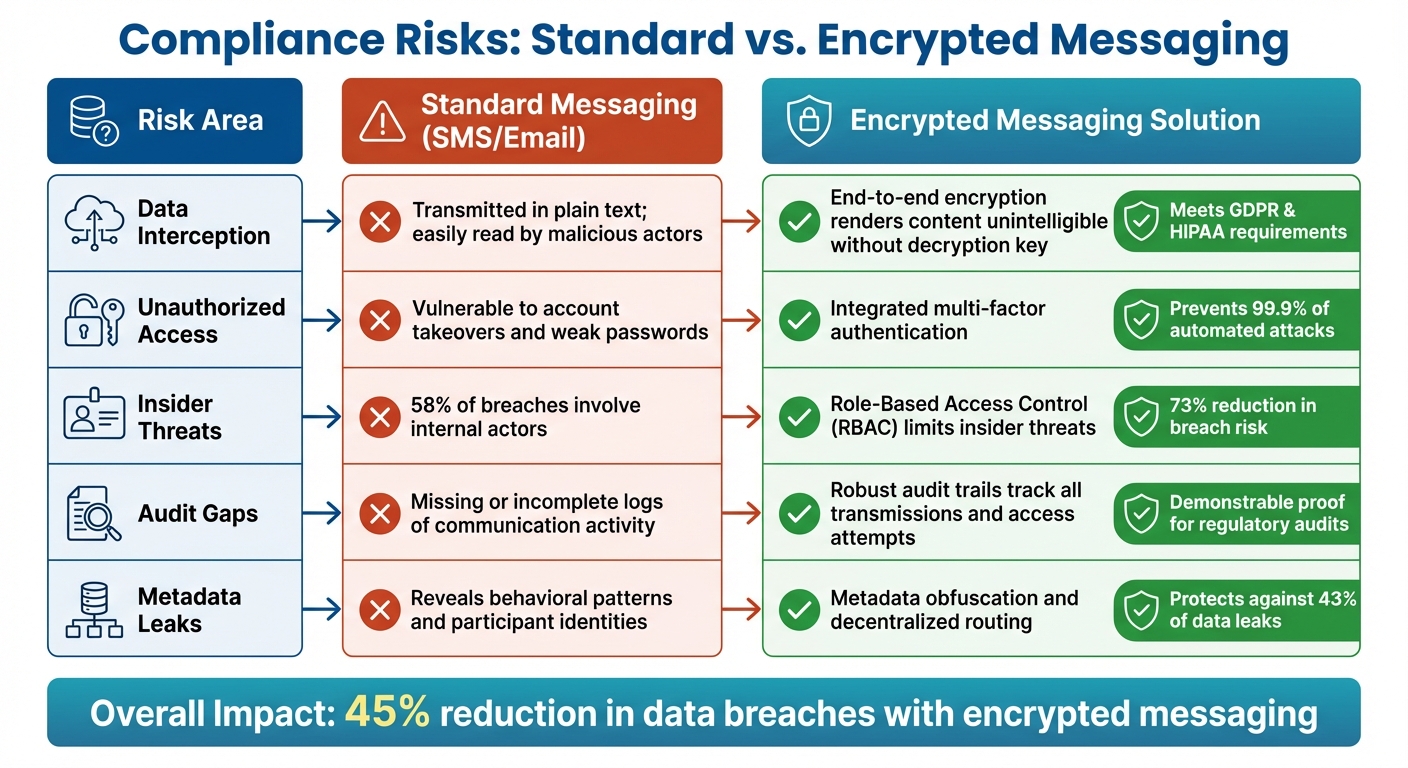
Compliance Risks: Standard Messaging vs Encrypted Messaging Solutions
Encrypted messaging offers a dual advantage: boosting security and making operations more efficient. Organizations leveraging encrypted messaging have reported a 45% reduction in breaches, effectively addressing vulnerabilities responsible for 80% of security incidents. This improvement not only enhances security but also streamlines processes, leading to smoother and more cost-effective operations.
The financial benefits are substantial as well. By preventing breaches, organizations avoid hefty fines, such as the staggering $3 billion in penalties for non-compliance. Additionally, predictable subscription costs make budgeting easier and more reliable.
From an operational perspective, encrypted messaging brings significant advantages. Automated integrations with systems like EHRs and CRMs eliminate the need for manual data entry, while centralized audit trails simplify compliance reviews. For example, healthcare providers can make quicker decisions when patient conversations are automatically archived. These features demonstrate how encryption becomes a key element in maintaining compliance.
Encrypted messaging also tackles insider risks and automated attacks effectively. With role-based access controls (RBAC) and multi-factor authentication, it drastically reduces threats from within and blocks automated attacks. Insider threats account for 58% of breaches, but organizations using RBAC have seen a 73% drop in security breaches. Meanwhile, multi-factor authentication prevents 99.9% of automated attacks, addressing risks tied to weak passwords.
Comparison Table: Compliance Risks Before and After Encryption
| Risk Area | Standard Messaging (SMS/Email) | Encrypted Messaging Solution | Compliance Benefit |
|---|---|---|---|
| Data Interception | Transmitted in plain text; easily read by malicious actors. | End-to-end encryption renders content unintelligible without the decryption key. | Meets GDPR and HIPAA requirements for data confidentiality. |
| Unauthorized Access | Vulnerable to account takeovers and weak passwords. | Integrated multi-factor authentication. | Prevents 99.9% of automated attacks. |
| Insider Threats | 58% of breaches involve internal actors. | Role-Based Access Control (RBAC) limits insider threats. | Reduces breach risk by 73% through strict role delineation. |
| Audit Gaps | Missing or incomplete logs of communication activity. | Robust audit trails track all transmissions and access attempts. | Provides demonstrable proof of compliance for regulatory audits. |
| Metadata Leaks | Reveals behavioral patterns and participant identities. | Metadata obfuscation and decentralized routing. | Protects against correlation attacks (43% of data leaks). |
Conclusion: Protect Your Communications with Encrypted Messaging
In regulated industries, compliance isn't just a box to check - it's essential for safeguarding your organization and clients. With unsecured communications contributing to 80% of data breaches, the risks are too significant to ignore. These vulnerabilities can lead to billions in regulatory fines and even criminal liability.
Encrypted messaging offers a way to turn these challenges into an opportunity. By leveraging end-to-end encryption, detailed audit trails, and built-in access controls, Eleidon addresses the weaknesses inherent in traditional SMS and email. This approach not only reduces data breaches by 45% but also ensures compliance with HIPAA and GDPR guidelines while supporting breach notification safe harbor.
Eleidon goes beyond encryption to deliver a complete solution tailored for regulated industries. Features like zero-knowledge architecture, cryptographic sender verification, custom domain support, and centralized team management make it a powerful tool for securing communications in healthcare, finance, and legal sectors.
As regulatory standards become stricter, organizations face mounting pressure to adopt secure messaging solutions. For example, the HHS is moving toward mandatory encryption for electronic Protected Health Information, and regulators are cracking down on ephemeral messaging practices. By adopting encrypted messaging now, organizations can stay ahead of these changes and protect themselves from over $3 billion in fines already levied against institutions with inadequate messaging compliance.
FAQs
What makes a message “HIPAA-compliant”?
A message is deemed HIPAA-compliant when encryption is used to securely transmit protected health information (PHI). Additionally, it must implement strict access controls and maintain detailed audit trails to uphold the confidentiality, integrity, and security of the data, as required by HIPAA's Security Rule.
How do audit logs work if messages are end-to-end encrypted?
Audit logs work seamlessly with end-to-end encrypted messages by capturing metadata, timestamps, and access records - all without revealing or decrypting the actual message content. This method strikes a balance, ensuring both compliance and accountability, while safeguarding the security and privacy of the communication.
What should we check before switching teams from SMS/email to encrypted messaging?
Before making the switch, it's crucial to ensure the platform provides end-to-end encryption to safeguard sensitive information. Additionally, confirm that it complies with key regulations like HIPAA or GDPR. Look for features such as strong user authentication, secure integration with electronic health records (EHR), metadata obfuscation to hide identifying details, and audit trails to track activity. These elements are essential for maintaining security, meeting compliance requirements, and ensuring accountability during the transition to encrypted messaging.