
Top 7 Features for GDPR-Compliant Messaging
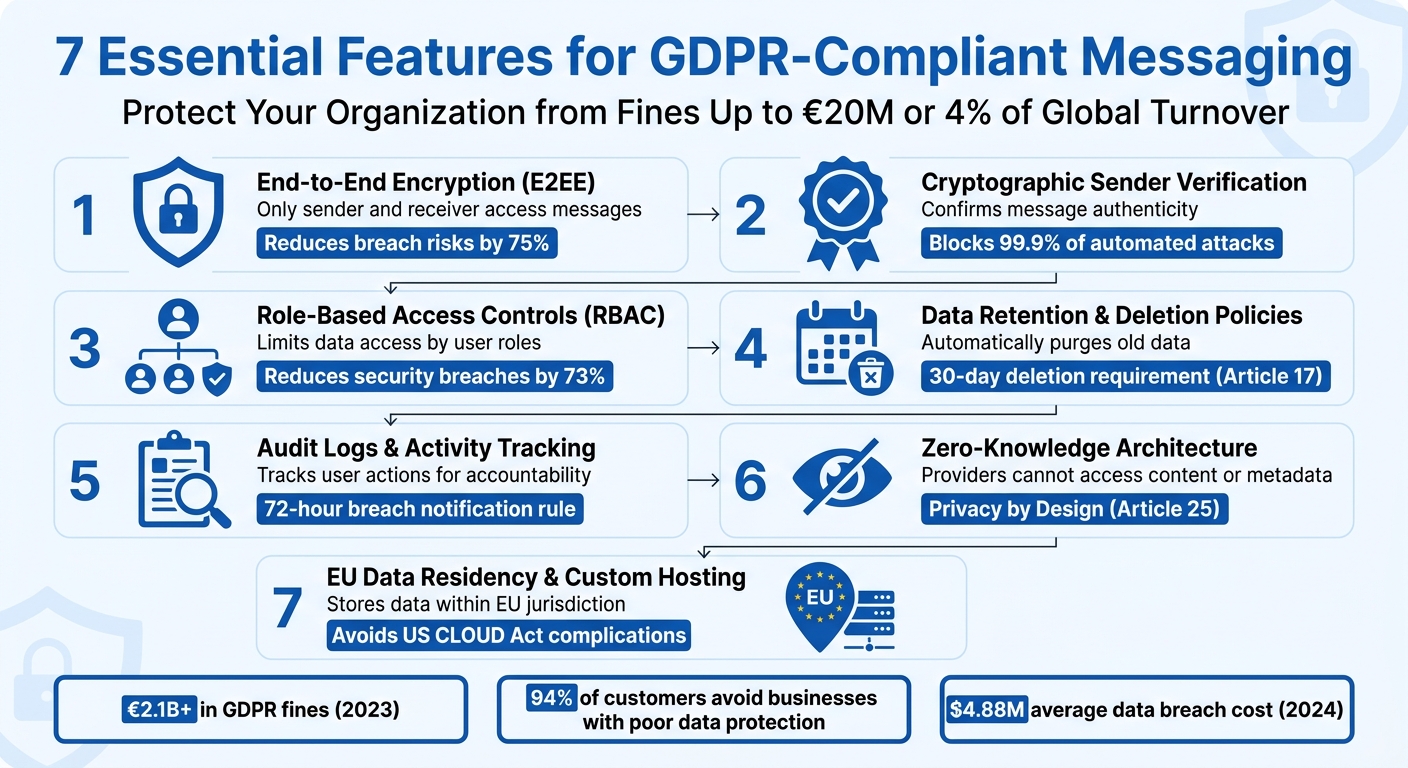
Protecting sensitive communication requires strict GDPR compliance. Messaging platforms must meet technical and legal standards to secure data and avoid fines of up to €20 million or 4% of global turnover. Here's what you need to know:
Key Features for GDPR-Compliant Messaging:
- End-to-End Encryption (E2EE): Ensures only sender and receiver can access messages, safeguarding against breaches.
- Cryptographic Sender Verification: Confirms message authenticity and prevents phishing.
- Role-Based Access Controls (RBAC): Limits data access based on user roles, reducing risks.
- Data Retention and Deletion Policies: Automatically purges old data to align with GDPR’s storage limitations.
- Audit Logs and Activity Tracking: Tracks user actions for accountability and breach investigations.
- Zero-Knowledge Architecture: Prevents service providers from accessing message content or metadata.
- EU Data Residency & Custom Hosting: Stores data within the EU to meet GDPR requirements and avoid cross-border issues.
Why It Matters:
- Fines: GDPR penalties exceeded €2.1 billion in 2023 alone.
- Trust: 94% of customers avoid businesses with poor data protection.
- Breaches: The average cost of a data breach reached $4.88 million in 2024.
Actionable Tip: Evaluate your messaging platform for these features today to stay compliant, protect user trust, and avoid costly penalties.
7 Essential GDPR-Compliant Messaging Features
The GDPR App Checklist No One Told You About (That Actually Works)
sbb-itb-804866a
1. End-to-End Encryption
End-to-end encryption (E2EE) is the backbone of any messaging system that aligns with GDPR requirements. It ensures that only the sender and recipient can access messages, blocking service providers, cloud hosts, or attackers from intercepting or decoding them. This approach directly supports GDPR principles for "security of processing" (Article 32) and "Privacy by Design" (Article 25).
True E2EE relies on decryption keys being controlled exclusively by the end users, not by the service operator. This user-only access is critical for meeting GDPR's security expectations. Research backs this up - encryption reduces breach risks by 75%, and 80% of cybersecurity experts consider strong encryption a necessity. Next, let’s look at the encryption standards that underpin effective E2EE.
Encryption Standards (e.g., AES-256)
Strong encryption protocols form the foundation of secure systems. AES-256 (Advanced Encryption Standard with 256-bit keys) is widely regarded as the industry benchmark for safeguarding data at rest, including stored messages, databases, and backups. While NIST allows for 128-, 192-, or 256-bit keys, the 256-bit option is preferred for long-term data protection. For data in transit, TLS 1.2 or 1.3 protocols are recommended. When it comes to asymmetric encryption and secure key exchanges, RSA-2048 or stronger standards are advised.
Proper key management is equally critical. GDPR mandates that encryption keys be generated using secure random generators, rotated regularly (at least annually), and stored separately from the encrypted data - often achieved using Hardware Security Modules (HSMs). Metadata, which can reveal sensitive patterns, must also be protected. Platforms like Eleidon address this by combining E2EE with zero-knowledge architecture, ensuring even metadata remains inaccessible to unauthorized entities.
These encryption measures not only protect sensitive information but also enhance system reliability and user confidence. Implementing E2EE has been shown to boost user trust by 30%, which often translates into increased productivity and stronger customer loyalty. Coupling E2EE with multi-factor authentication can block up to 99.9% of automated attacks. Additionally, cryptographic sender verification adds another layer of security by confirming message authenticity.
2. Cryptographic Sender Verification
Cryptographic sender verification relies on digital signatures and certificates to confirm that messages are both genuine and unaltered. This approach is a powerful defense against impersonation and man-in-the-middle attacks - two common tactics used in phishing campaigns aimed at stealing credentials or sensitive data. Considering that nearly 90% of data breaches are tied to phishing attempts, this feature plays a key role in ensuring GDPR-compliant systems.
Under GDPR, metadata - such as participant details and communication patterns - is classified as personal data. Cryptographic verification helps protect this metadata by securely handling it, ensuring accuracy, and creating audit trails. These trails demonstrate lawful data processing and limit access to authorized personnel. Beyond this, specific measures are designed to strengthen sender verification, making it an effective tool against phishing and unauthorized access.
Sender Verification and Anti-Phishing Measures
Building on digital verification, organizations can adopt additional anti-phishing measures to enhance security. For instance, using RSA with at least 2048-bit keys and integrating multi-factor authentication (like TOTP through Google Authenticator) can block 99.9% of automated attacks.
Implementing role-based access control (RBAC) is another critical step. By restricting employees’ access to only the resources necessary for their roles, organizations reduce the risk of internal vulnerabilities. Regularly auditing access logs - ideally on a quarterly basis - can help detect suspicious activity, such as logins from unusual locations or outside normal working hours. Eleidon takes this a step further by requiring users to approve contacts through a trust request system, preventing unsolicited messages while maintaining cryptographic verification.
Furthermore, the 2026 European Digital Omnibus reform introduces privacy-by-design as a technical requirement, effectively making cryptographic verification an essential element of secure messaging. With 81% of data breaches stemming from weak or compromised passwords, organizations must adopt verification systems that exceed traditional credential-based security to meet both compliance and protection standards.
3. Role-Based Access Controls
Data Minimization and Access Control
Role-Based Access Control (RBAC) ensures employees only have access to the data and functions necessary for their job responsibilities. This aligns with the GDPR's data minimization principle outlined in Article 5(1)(c). By limiting access based on roles, organizations significantly lower the chances of data exposure.
Statistics show the value of RBAC: it has reduced security breaches by 73%, with 60% of breaches being internal and 75% resulting from excessive permissions. RBAC also strengthens accountability by logging access events, which are critical for audit trails during regulatory reviews or Data Subject Access Request (DSAR) responses. Implementing strong access management practices can reduce overall risk exposure by as much as 40%.
When paired with encryption and verification, RBAC adds a vital layer of protection. However, its effectiveness relies on well-defined roles and regular access reviews. Quarterly reviews of access logs can help identify unusual activity, like access during odd hours or from unexpected locations. Automated systems that revoke permissions when roles change are also essential to prevent "permission creep" - a common issue where users retain unnecessary access over time.
Eleidon's system integrates RBAC with cryptographic verification, creating a multi-layered defense strategy. This ensures RBAC works seamlessly with sender verification to safeguard sensitive communications effectively.
4. Data Retention and Deletion Policies
Data Retention Essentials
Under GDPR Article 5(1)(c), organizations are required to keep personal data only for as long as it’s necessary for their operations. Messaging systems must adopt measures like automatically purging old messages once they’ve served their purpose. For example, one-time passwords (OTPs) might only need to be stored for a few hours, while delivery logs could be retained for 90–180 days to meet legal requirements.
Timely data deletion is equally important. Article 17 - commonly referred to as the Right to Erasure - mandates that messaging platforms delete individual messages, metadata, and even user data within one month of a user’s request. Rocket.Chat highlights the importance of mapping messaging data across all storage locations, including databases, logs, queues, support tools, and backups, to ensure compliance with this requirement.
Failing to meet these standards can result in steep fines and increased risks of data breaches. Beyond regulatory consequences, user trust is at stake - 94% of organizations report that customers are less likely to buy from companies that don’t safeguard their data.
Automated retention policies are a practical way to align with data minimization principles. Setting default retention periods - such as seven days for media attachments - and implementing automatic purging mechanisms can help ensure compliance. For businesses handling sensitive communications, separating transactional messages (like password resets) from marketing messages allows for tailored retention and consent policies. Regular audits, conducted at least once a year, can further identify and address compliance gaps before they escalate into major issues.
These practices are not just about meeting legal requirements; they also play a key role in strengthening a platform’s overall security strategy. For instance, Eleidon’s system architecture integrates retention controls and efficient data deletion processes, ensuring sensitive communications are protected throughout their lifecycle. By combining data minimization with robust deletion protocols, organizations can maintain compliance while safeguarding user trust.
5. Audit Logs and Activity Tracking
Accountability is a cornerstone of GDPR compliance, and audit logs play a key role in maintaining it. Along with encryption and cryptographic verification, audit logs provide a detailed record of transactions, ensuring that organizations can meet regulatory requirements when needed.
These logs aren't just for record-keeping - they're essential for meeting GDPR rights like Data Subject Access Requests (DSARs). When a DSAR is filed, audit trails make it easier for teams to locate, export, or delete specific user data across multiple systems. In the event of a data breach, logs are indispensable for meeting the 72-hour notification rule, offering insights into who accessed the data, when, and how. Without proper audit logging, organizations risk missing signs of a breach entirely, leaving them unaware of unauthorized activity.
To meet GDPR standards, logs should include key details such as user identifiers, timestamps, specific actions taken, device information, and updates on message statuses (e.g., sent, delivered, read). Regulators now view metadata - like message timing, participant details, and communication frequency - as being just as critical as the message content itself.
Automated anomaly detection is now a best practice for many organizations. Real-time alerts for suspicious activity, like logins from unusual locations or access attempts during off-hours, can help mitigate risks. This is crucial, as 63% of data breaches stem from unauthorized access, and 30% involve internal actors. To further secure these logs, Role-Based Access Control (RBAC) should limit who can view or export them, ensuring only top-level administrators handle these sensitive records.
Organizations should also define strict retention policies for logs - usually between 90 and 180 days for operational purposes. Automated scripts can delete expired metadata to comply with GDPR's "Storage Limitation" principle. Logs should be protected with AES-256 encryption while stored and TLS 1.3 during transmission to prevent tampering.
Platforms like Eleidon incorporate these logging features seamlessly. By combining cryptographic sender verification with comprehensive logging, Eleidon ensures that every communication event is securely tracked while maintaining zero-knowledge privacy for message content. This approach strengthens the platform's GDPR compliance framework, offering both security and accountability.
6. Zero-Knowledge Architecture
Zero-knowledge architecture builds upon end-to-end encryption by ensuring that only end users - not the platform operator - have access to decryption keys. In this setup, decryption keys stay exclusively on user devices, meaning service providers cannot access the actual content of messages.
This design aligns perfectly with GDPR's "Privacy by Design" mandate outlined in Article 25, which became a required technical standard under the 2026 European Digital Omnibus reform. By minimizing data collection at its core, zero-knowledge architecture ensures that providers handle only encrypted ciphertext rather than readable personal data. This directly supports GDPR's data minimization principle under Article 5(1)(c).
Zero-knowledge architecture also tackles key compliance challenges. Regulators now treat metadata - such as message timing, participant details, and communication patterns - with the same level of scrutiny as actual message content. Without strong encryption, organizations face heightened risks, with weak encryption identified in 53% of data breach incidents. By addressing these vulnerabilities, zero-knowledge architecture lays a strong foundation for more advanced security measures.
Data Minimization and Access Control
Encryption alone isn’t enough; effective access controls are critical to uphold the zero-knowledge standard. Platforms adopting this model should integrate AES-256 encryption for stored data and TLS 1.3 for data in transit. However, encryption must be coupled with stringent access management. Role-Based Access Control (RBAC) is essential to ensure that administrative privileges don’t allow access to encrypted message content. Some systems go further by implementing field masking, which restricts authorized agents from viewing sensitive personal data, such as health or financial information.
Eleidon’s zero-knowledge architecture exemplifies this approach by ensuring that only users control their encryption keys, eliminating any possibility of third-party decryption. Organizations maintain complete control over their keys, while features like custom domain support and centralized team management provide the necessary administrative oversight for GDPR compliance - without sacrificing message privacy. This setup works seamlessly with other security measures, such as end-to-end encryption, cryptographic verification, and role-based access controls, creating a robust framework for compliance and data protection.
7. EU Data Residency and Custom Hosting
Data Residency and Hosting Options
Where your messaging data is physically stored has a big impact on its legal protections. Keeping data within the EU or European Economic Area (EEA) ensures it falls under GDPR regulations, avoiding the challenges of cross-border data transfers. It also shields data from laws like the US CLOUD Act, which could potentially override EU privacy rules. This provides a solid foundation for implementing custom hosting options that enhance data control.
Custom hosting options - whether on-premises, private cloud, or EU-based cloud - build on data residency compliance by offering full data ownership. These solutions prevent third-party vendors from accessing conversations and metadata, while also simplifying compliance. Without international data transfers, there’s no need for Standard Contractual Clauses (SCCs) or Transfer Risk Assessments[2,3]. As Rocket.Chat explains:
Organizations handling sensitive communications should deploy messaging infrastructure they fully control, either on-premises or in a private cloud within EU jurisdiction.
The financial stakes are high: the average global cost of a data breach is projected to hit $4.88 million in 2024 - a 10% increase from the previous year. Additionally, 94% of organizations report that customers would refuse to buy from them if they don’t provide adequate data protection. These figures make a strong case for prioritizing data sovereignty.
Eleidon's Team and Team + Vault plans offer custom domain hosting, enabling organizations to maintain complete control over their messaging infrastructure while ensuring EU data residency. This approach combines strict GDPR compliance with the privacy guarantees of zero-knowledge architecture, keeping both message content and metadata firmly under the organization’s control.
| Hosting Option | GDPR Benefit |
|---|---|
| On-Premises | Full data ownership and physical security with no third-party access |
| EU Private Cloud | Maintains data ownership while leveraging cloud efficiency; simplifies SCC compliance |
| Hybrid Hosting | Keeps sensitive data on-site while using the cloud for less critical workflows |
Conclusion
GDPR compliance is a non-negotiable requirement for any organization handling the personal data of EU residents. The seven features discussed work together to build secure messaging systems that meet these stringent regulations. Features like end-to-end encryption and zero-knowledge architecture ensure confidentiality, while audit logs and role-based access controls provide the accountability regulators expect. Data residency options and automated retention policies address data sovereignty and user rights, and cryptographic sender verification helps thwart phishing attempts and unauthorized access.
These components form a solid foundation for both data security and regulatory compliance. To put the stakes into perspective, GDPR fines in 2023 exceeded €2.1 billion, with penalties reaching as high as €20 million or 4% of global annual turnover. On top of that, the average cost of a data breach rose to $4.88 million in 2024.
Organizations must act now to evaluate and improve their messaging systems. A critical step is verifying whether your platform can delete individual messages and user data upon request. As Sara Ana Cemazar from Rocket.Chat emphasizes:
If your platform cannot delete individual messages or user data on request, it is non-compliant regardless of what your terms of service say.
For those in search of an all-in-one solution, Eleidon offers a comprehensive suite of features, including end-to-end encryption, cryptographic sender verification, custom domain hosting with EU data residency, and zero-knowledge architecture. Its trust request system eliminates phishing risks while maintaining full GDPR compliance, making it an ideal choice for industries like healthcare, legal services, and finance.
Take action now - audit your messaging tools, ensure Data Processing Agreements are in place with vendors, and test your platform’s ability to respond to data subject requests within the 30-day timeframe. With 94% of organizations reporting that customers would avoid businesses lacking adequate data protection, secure messaging is not just about avoiding penalties - it’s about preserving trust in a world that values privacy more than ever.
FAQs
How can I verify a messaging app is truly end-to-end encrypted?
To ensure a messaging app truly provides end-to-end encryption, start by confirming that its encryption protocols have undergone independent audits. These audits help verify the security measures in place. Encryption should also be enabled by default for all types of communication, including text messages, media files, and voice or video calls.
Additionally, check whether the app avoids syncing your contacts or storing metadata. These practices can pose privacy risks and may even breach regulations like GDPR. By verifying these aspects, you can be confident that your messages remain secure and private, accessible only to the sender and recipient.
Does GDPR treat message metadata as personal data too?
Yes, under GDPR, message metadata is classified as personal data if it pertains to an identified or identifiable individual. This includes details like timestamps, sender and recipient information, and even technical data about the communication.
Even when metadata is anonymized or pseudonymized, it remains protected under GDPR. Why? Because there’s still a possibility that it could be used to re-identify someone. This means organizations must handle metadata with the same care and compliance as other types of personal data.
What’s the simplest way to test if a platform can handle deletion requests on time?
To evaluate whether a platform handles deletion requests efficiently, first confirm if it supports user deletion rights. This includes providing users with a straightforward way to request data erasure. Once you submit a deletion request, observe how long it takes to process. Platforms adhering to GDPR standards should not only process requests within the required timeframe but also have clear, documented procedures for managing data deletion requests.